I left before finals. Three of my teams still made it.
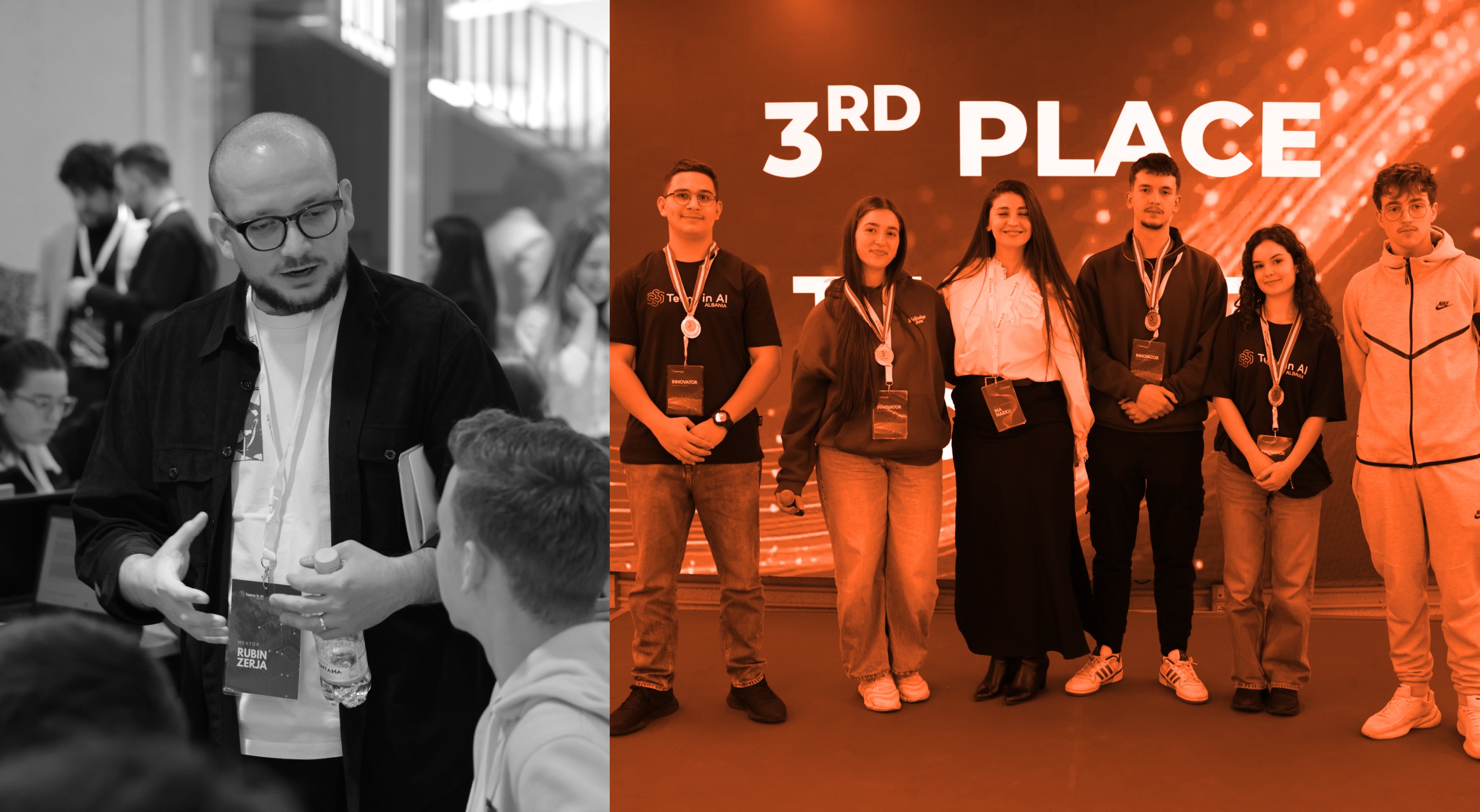
I arrivedat Piramida at 8AM and for a moment I forgot I was an adult.
The courtyard was filling up fast, teenagers coming in with their parents, backpacks, nervous energy. Some were loud, some were half asleep, some were scanning the room with that particular look of someone trying to figure out where they belong. It felt exactly like the first day of school. Loud, chaotic, slightly overwhelming. And then the groups formed, teams assembled, and everything started moving at once.
170 teenagers. 35 teams. 21 mentors. One day to build an AI solution for a real-world problem, present it to a jury, and compete for the chance to represent Albania at the global Teens in AI stage.
I was one of the business mentors, assigned to teams 25 through 30. Each team had three mentors rotating through, one technical, one from academia, one for business. That was me. And I said yes to this without hesitating, because I've always believed that teenagers carry a kind of energy that most adults have quietly traded away.They still think they can change the world. That's not naivety. That's the starting point of everything worth building.

My job as the business mentor was to help each team connect their idea to the real world. To make sure the problem they were solving was actually a problem worth solving, that it connected to the UN Sustainable Development Goals the event was built around, and that they could explain it clearly to a jury in a few minutes. That last part, the pitch, is where I spent most of my time.
I didn't give them a slide-by-slide template. I gave them a framework: PAS. Problem, Agitation, Solution. What is the problem. Why does it actually matter, who suffers, what are the consequences of leaving it unsolved. And then what you've built to address it. Three things. In that order. Simple enough to remember under pressure, flexible enough to work for any idea.
I wanted them to understand the framework, not just execute it. Because if you understand why a pitch is structured the way it is, you can adapt it. You can use it next year, and the year after. You carry it with you. So I explained the logic behind each part, let them fill it in themselves, and pushed back when the story wasn't landing. And they moved fast. Faster than I expected.

The team that stuck with me most was Team 27. They had come across a statistic that stopped them: around 70% of fatal car accident victims are women, not because women are worse drivers, but because vehicle safety standards were historically designed around male body measurements. The crash test dummies, the impact simulations, the seatbelt positions, all built with a male body as the default. Women were an afterthought.
They built a working MVP that simulated crash tests across different variables, weather and road conditions, vehicle weight, speed, body height, weight, and shape, to show what safety could look like when it's designed for everyone. It was sharp. It was specific. It connected a real injustice to a concrete technical solution, and they could explain exactly why it mattered.
What impressed me as much as the idea was how they worked. They were coachable in the best possible way, they listened, they pushed back when something didn't feel right, they went away and came back with something better. That combination is rare. Most people either accept everything you say without thinking or reject feedback defensively. These teenagers did neither. They engaged with it.
Team 27 finished third overall. Two of my other teams, Team 29 and Team 30, placed fourth and fifth. Three of my six teams in the top five. I won't pretend I expected that. I was genuinely surprised. But I think the truth is simpler than luck: they were ambitious, they absorbed the framework quickly, and they executed under pressure. I just gave them the structure. They did the rest.

Not every team made the finals. And the hardest moment of the day had nothing to do with results.
One of the teams I had worked with through the pitch ended up following a different structure in the final version, something closer to a keynote than a pitch.And somewhere in the process, the version we had built together got deleted. By accident, by the pressure of the day, I don't know. One of the girls on the team started crying.
It wasn't hard for me to handle practically. But it stopped me. Because what I saw in that moment wasn't failure, it was how much they cared. These kids had their ideas in their hearts. This wasn't a school project to them. It was real. They had been dreaming about this all day, and now something had gone wrong, and it felt enormous.
I took her aside and told her what I believed: this is not the end. What you learned today, about pitching, about building under pressure, about working in a team when things go sideways, most people don't learn that until their late twenties. You're learning it now. That's an advantage, not a consolation. Keep the fire.
She relaxed. They went on. And I carried that moment with me for the rest of the day.

I had to leave before the final presentations to speak at another event. I didn't get to see the teams pitch. I didn't get to be in the room when the results were announced. I found out later, through messages, that Team 27 had won third place.
When I was walking out, some of the team members found me and stopped me in the hallway. They thanked me for believing in their idea and for helping them get there. That was the moment the whole day crystallised for me. Not the results, not the ranking, that moment in the hallway.
A few days later, the mother of one of the team members sent me a message. She said her son had felt really good with me mentoring him. That landed differently than I expected. It felt personal in a way that a lot of professional wins don't.

I was invited to this outside of STUDIOZ. But I don't separate the two easily. The way I mentor teenagers is the same way I think about brand and business with founders, find the real problem first, shape the story around it, make it clear enough that anyone can understand it in thirty seconds. The frameworks are the same. The belief underneath them is the same: complexity is usually a failure of clarity, not a sign of depth.
If a group of teenagers can absorb a pitching framework in a few hours, use it under pressure, and finish in the top five out of 35 teams, that says something. Not about them being exceptional. About what happens when you give people the right tools and trust them to use them.
That's what I took home from Teens in AI Techathon. Not a lesson I hadn't heard before. A reminder of why it matters to keep showing up and sharing what you know, because somewhere in a room of 170 people, someone is going to take it further than you expected.
And that alone is worth the whole day.

